
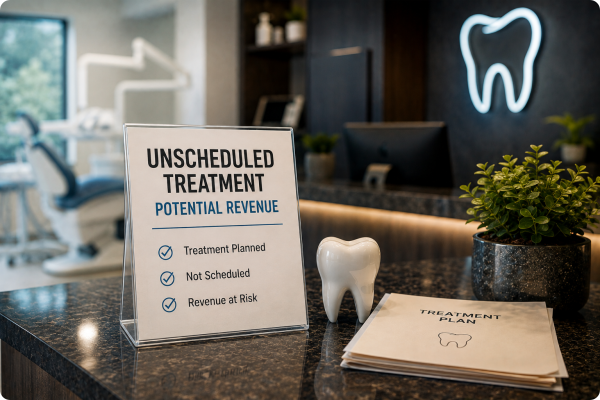
Unscheduled Dental Treatment: The Revenue Already Sitting Inside Your Practice
You’re looking at next month’s production, and there are more openings on the schedule than you’d like. Maybe there are a few afternoons that should be fuller, a doctor’s schedule that feels lighter than expected, or production simply isn’t tracking where you want it to be.
Naturally, your attention starts moving toward marketing.
Do you need more new patients? Should you increase the Google Ads budget? Is your marketing company generating enough opportunities? Would another campaign help fill the schedule?
Those may eventually be the right questions, but there’s another place we’d look before spending more money to bring someone new through the front door.
We’d look at your unscheduled treatment.
One of the patterns we see in businesses is that owners naturally focus on creating the next opportunity because the opportunities that already entered the business are much harder to see. In a dental practice, that can happen every day. A patient receives a diagnosis, understands the recommended treatment, walks to the front desk and leaves without scheduling.
Nothing dramatic happens.
Nobody thinks the patient has been lost.
The team expects them to call back, the patient probably intends to call back, and everyone moves on to the next patient.
Three months later, the treatment may still be sitting inside your practice management system without a clear next step.
Meanwhile, you’re preparing to spend more money finding another patient.
That’s why we believe unscheduled dental treatment deserves your attention before you automatically assume your next production goal requires more new-patient acquisition.
Start With the Report You May Not Be Looking at Often Enough
Open your practice management system and pull your unscheduled treatment report.
Depending on the software you use, it may have a slightly different name, but you’re looking for patients with diagnosed or recommended treatment that hasn’t made it onto the schedule.
When we look at a report like this, the first thing we don’t do is treat the total dollar amount as recoverable revenue.
That can be misleading.
If your system shows $300,000 in unscheduled treatment, you don’t suddenly have $300,000 waiting to be collected. Some of that treatment may be old, some patients may have gone somewhere else, others may have explicitly declined, and there may be treatment that is no longer clinically relevant.
What matters initially is understanding what’s actually inside the report.
How much of the treatment is recent? How many patients never explicitly declined? How many intended to schedule but didn't? How many had a question or concern that was never resolved? How much of the treatment received meaningful follow-up after the patient left?
Once you begin separating those situations, the report becomes much more useful.
You’re no longer staring at a giant theoretical production number. You’re looking at individual patient journeys and asking where they stopped.
That’s where the opportunity usually becomes visible.
The Patient Who Didn't Schedule Didn't Necessarily Say No
This is one of the distinctions that matters most when looking at unscheduled dental treatment.
A patient can leave without an appointment for dozens of reasons that have very little to do with whether they trust the doctor or believe they need treatment.
Think about what may have happened during their visit.
They came in expecting a routine appointment and learned they need a crown. Maybe they knew something was wrong, but the treatment turned out to be more extensive than they expected. Perhaps you discussed an implant, restorative work or another treatment that requires a meaningful financial and scheduling commitment.
The doctor explains the diagnosis, shows the patient what’s happening and answers their questions. The patient understands the recommendation and may even agree that they need to take care of it.
Then they arrive at the front desk.
“When would you like to schedule?”
Now another decision has to be made.
The patient may need to look at their work calendar, talk with their spouse, understand what insurance will cover or simply have a little time to process everything they just heard.
So they say, “Let me check my schedule and I’ll call you.”
Your team says, “Absolutely.”
That can be a completely appropriate conversation.
The problem isn’t what happened at the front desk.
The problem is what happens afterward.
We've Seen How Easily a Good Intention Can Become No Next Step
This is where the realities of running a dental practice matter.
The patient who left at 11:30 saying they’ll check their calendar is still fresh in everyone’s mind at 11:35. Your front desk may genuinely intend to follow up if they don’t hear back.
Then noon arrives.
A patient needs help understanding insurance. Someone calls to cancel Thursday’s appointment. Another patient is waiting to check out. The phone rings twice, a provider needs something, and suddenly the person who left earlier isn’t the most important thing happening anymore.
By tomorrow, another group of patients has moved through the practice.
Nothing went wrong in an obvious way.
Your team wasn't careless, and the patient didn't reject you.
The conversation simply lost momentum.
This is something we pay close attention to because revenue leaks often don't look like failures while they're happening. They look like ordinary moments inside a busy business.
That's what makes them difficult to see.
A patient saying, “I'll call you,” doesn't create an alarm in your practice management system. Nobody receives a warning that this person may still fully intend to move forward but doesn't have an appointment.
Unless you have a defined process that brings that patient back to someone’s attention, the next step may depend almost entirely on memory.
And memory isn't a reliable system.
Before You Blame the Front Desk, Look at the Process You've Given Them
When unscheduled treatment starts getting attention, one of the easiest reactions is to assume the team needs to become better at follow-up.
Sometimes training or accountability does need attention.
But that's rarely where we'd start.
When you actually look at what happens inside a busy practice, you usually don't find employees sitting around ignoring opportunities. You find people juggling competing priorities.
Your front desk is checking patients in and out, answering incoming calls, managing cancellations, helping with insurance questions, collecting payments and trying to keep the schedule moving. They may also be responsible for website inquiries, missed calls, new-patient follow-up and whatever unexpected problem appeared that morning.
Now add a list of patients who left two weeks ago with unscheduled treatment.
Those patients matter, but they aren't physically standing at the desk demanding attention.
So the work gets pushed to whenever there's time.
And as you already know, “when there's time” can disappear for an entire week in a busy dental practice.
That's why we'd want to know whether your treatment plan follow-up depends on a good employee remembering what needs to happen or whether the practice has actually built a repeatable process around it.
Ask your team what happens when a patient leaves without scheduling.
Who owns the next step?
How soon does follow-up occur?
Where is the outcome documented?
What happens when the patient doesn't answer?
If the patient says, “Call me after the 15th,” what ensures that actually happens?
How does the team know when the patient eventually schedules so unnecessary follow-up stops?
The answers tell you whether you have a system or a collection of good intentions.
Case Acceptance Doesn't Always Mean Treatment Gets Scheduled
This is another area where we've learned to look beyond the headline number.
You may have a healthy dental case acceptance rate and still have meaningful treatment sitting unscheduled.
That's because several things have to happen between a doctor presenting treatment and the patient actually completing that treatment.
The patient first has to understand the diagnosis and why the recommended care matters. They need to feel comfortable with the treatment itself, understand the financial side, work through scheduling and eventually make it onto the calendar.
Then they still need to show up and complete the care.
A patient can agree with everything the doctor said and still stop somewhere in that journey.
That's why looking only at whether treatment was presented or verbally accepted doesn't always tell you enough.
You want to know what happened next.
When we trace revenue leaks, that's often where the useful information appears. The breakdown may not be in case presentation at all. It may be between acceptance and scheduling, between scheduling and showing up, or after a patient asks for additional time.
Once you know the stage where patients are stopping, you can work on the actual problem instead of guessing.
Your Unscheduled Treatment Report Can Tell You More Than You Think
One mistake we try to avoid is treating an unscheduled treatment report as simply a call list.
There’s much more information hiding inside it.
When your team reconnects with patients, pay attention to what those patients are actually telling you.
Maybe you begin noticing that a significant number of patients don't understand what their insurance will cover. Perhaps patients want treatment but aren't clear about financing options. Some may be nervous about the procedure, while others don't feel much urgency because nothing currently hurts.
You may also hear something you didn't expect.
A patient might say, “I thought someone was going to call me back.”
That's a very different problem.
Another may tell you they were waiting for information from your office. Someone else may have assumed the practice would contact them when insurance was verified.
Those conversations help you see what the report alone cannot.
If the same reason appears repeatedly, you may have found an upstream problem that can be addressed before patients ever become unscheduled.
For example, if financial uncertainty repeatedly stops treatment from moving forward, the opportunity may be improving how those conversations happen before the patient leaves. If patients don't understand the urgency of treatment, you may need to look at how that information is being communicated.
The objective isn't to find someone to blame.
It's to understand where friction is entering the patient journey.
Don't Turn Treatment Follow-Up Into a Sales Campaign
There's an important line here.
When you see a meaningful amount of unscheduled treatment, it's tempting to start thinking about how much of it you can “close.”
We don't think that's the right way to approach it.
These are your patients, not sales leads sitting at the bottom of a funnel.
They're making healthcare decisions that may involve fear, finances, discomfort, family considerations and uncertainty. Your treatment plan follow-up should respect that.
Sometimes the appropriate next step is scheduling. Sometimes it's answering a question the patient didn't think to ask while they were in the office. In other cases, it may mean reconnecting at a time the patient specifically requested.
And sometimes the patient simply doesn't want to move forward.
That's an answer too.
The purpose of follow-up isn't to pressure every patient into treatment. It's to make sure the patient isn't unintentionally lost because neither side knew what should happen next.
The best treatment follow-up should feel like the care experience continuing after the patient leaves your office, not like a sales campaign that started because their name appeared on a report.
Here's Where We'd Start Inside Your Practice
When an owner sees a large unscheduled treatment report for the first time, the instinct can be to attack the whole thing.
We wouldn't.
If you have hundreds or thousands of old treatment items, handing that list to your front desk tomorrow morning will probably create more frustration than production.
We'd start with recent treatment because it gives you the clearest picture of how your current process is working.
Look at the last 30 to 90 days and identify patients with meaningful recommended treatment who haven't scheduled.
Then take 20 of them.
Not 500.
Twenty.
Open the first patient's record and reconstruct what happened from the treatment conversation forward. Look at what was recommended, whether the patient gave a reason for not scheduling, what was documented and whether any follow-up happened after they left.
Then do the same thing with the remaining patients.
What you're looking for isn't simply the dollar amount.
You're looking for patterns.
Maybe several patients asked for a callback and never received one. Perhaps your team consistently makes one follow-up attempt but there's no defined process after that. You may find that the majority of patients had financial questions, or that several patients actually scheduled later but the report wasn't updated in a way that made that obvious.
You may also discover patients who clearly aren't opportunities anymore.
That's useful too.
The goal isn't to make the opportunity look bigger than it really is. The goal is to understand what's actually happening.
The 20-Patient Test Can Tell You a Lot About Your Practice
We've found that you often don't need a massive data project to recognize an operational pattern.
Twenty patient journeys can be incredibly revealing.
Imagine that you review those 20 patients and discover six were never contacted after leaving without scheduling, four received one voicemail, three asked to be contacted later but no reminder existed, two explicitly declined and five eventually scheduled.
Now you know something you didn't know before.
You don't simply have “unscheduled treatment.”
You have several different situations requiring different responses.
The patients who declined should be treated differently from the patients who asked to reconnect. The patient who received one unanswered voicemail is different from the patient who is waiting for an insurance question to be resolved.
When all of those people sit on one report, they look like the same problem.
They're not.
This is why visibility comes before automation for us.
You need to understand what the problem actually is before deciding what tool should solve it.
Now Look at the Production Opportunity Using Your Own Numbers
Once you've cleaned up the report and separated genuinely actionable treatment from everything else, look at the financial value.
Use your own numbers.
I'd rather have you discover what unscheduled treatment means inside your practice than give you an industry statistic claiming the average dentist is losing some dramatic amount every year.
Suppose you identify a meaningful amount of recent treatment associated with patients who haven't declined and still don't have a clear next step.
Now ask how much of that treatment received documented follow-up.
How much didn't?
How much has been sitting for more than 30 days?
What happens to treatment after 60 or 90 days?
How much eventually gets scheduled when someone appropriately reconnects with the patient?
Those numbers begin telling you something meaningful about your revenue recovery opportunity.
More importantly, they're your numbers.
You're no longer being told by ExitLoop that you might have a revenue leak.
Your own practice is showing it to you.
This Is Where We'd Compare Revenue Recovery Against More Marketing
Now let's go back to the problem that brought you here.
You want more production.
Your schedule has openings, and you're considering putting another few thousand dollars into marketing to generate more new patients.
There may be nothing wrong with doing that.
But now suppose your review shows that you already have a meaningful amount of recent treatment associated with patients who haven't declined, haven't scheduled and haven't received consistent follow-up.
That changes the conversation.
Before asking how much another 50 leads will cost, we'd want to know what happened to the patients you've already spent money and time acquiring.
Your practice already earned their attention.
They already walked through the door.
Your team already built a relationship with them.
Your doctor already invested clinical time diagnosing their needs.
That's a lot of work already completed.
If there's a breakdown between that point and the schedule, sending more people through the same process doesn't automatically solve it.
It may simply create more unscheduled treatment.
That's why we look at revenue recovery before assuming revenue growth always requires more acquisition.
One of the Biggest Mistakes Is Fixing the Backlog but Not the Process
This is something we've seen happen in different forms across businesses.
Someone finally looks at an old list and realizes there's a lot of opportunity sitting there. Everyone gets energized, the team launches a campaign, calls get made and some opportunities come back.
For a while, it feels like the problem has been solved.
Six months later, the list is full again.
That's because the backlog was addressed, but the process creating the backlog never changed.
You can absolutely recover old unscheduled dental treatment, and doing so may produce meaningful results. But the bigger opportunity is preventing today's treatment recommendations from quietly becoming next year's recovery campaign.
That means creating a clear process while the patient conversation is still fresh.
When a patient leaves without scheduling, someone or something needs to know what happens next. When they ask to be contacted after a particular date, that shouldn't depend on a sticky note or someone's memory. When they decline, the record should reflect that appropriately so they aren't repeatedly contacted.
The cleaner the process becomes today, the less time your team will spend trying to resurrect old opportunities later.
Technology Can Support the Process, but It Shouldn't Define It
Once you understand the workflow, technology becomes much more useful.
A CRM can help organize conversations and keep outstanding opportunities visible. Automation can create reminders, manage appropriate follow-up sequences and reduce the amount of repetitive work your team has to remember manually.
AI may also play a role when it makes sense.
But we wouldn't start by asking how much of your unscheduled treatment follow-up can be automated.
We'd start by asking what a good process should look like.
When does a human conversation matter? What communication can appropriately happen automatically? What happens when a patient replies with a clinical or financial question? How does the system recognize someone who specifically asked to be contacted later? When should follow-up stop?
Once those rules are clear, technology can help your team execute them consistently.
Without that clarity, you're simply automating whatever process already exists, including the parts that may not be working.
That's why at ExitLoop we don't approach revenue recovery as an AI problem.
AI is one tool.
Sometimes the biggest improvement is automation. Other times it's a better workflow, clearer ownership, improved reporting or simply connecting systems and conversations that weren't communicating with one another.
The solution should follow the problem.
Pay Attention to What Happens Over the Next 30 Days
Once you begin addressing recent unscheduled treatment, don't measure success only by how much production gets scheduled.
Pay attention to what you learn.
Track how many patients actually respond, what questions they have and why they didn't schedule originally. Look at how many asked to be contacted later, how many had unresolved financial concerns and how many simply needed a reminder.
You may begin seeing patterns that affect other parts of your practice.
Perhaps one provider consistently has more unscheduled treatment than another. That doesn't automatically mean there's a problem with the provider, but it's worth understanding why.
Maybe a particular procedure repeatedly stalls at the financial conversation.
Perhaps treatment presented on certain days receives less consistent follow-up because the front desk is overwhelmed.
Those patterns can help you improve the system upstream rather than endlessly chasing treatment downstream.
That's when revenue recovery becomes more than simply bringing old opportunities back.
It starts making the practice better at preventing those opportunities from being lost in the first place.
There May Be a Patient on Your Report Who Still Fully Intends to Come Back
This is the part that's easy to forget when you're looking at rows on a report.
Those aren't just treatment codes and dollar amounts.
One of those rows may be a patient who trusts you completely and fully intends to return for the crown you recommended.
They haven't rejected the treatment.
They haven't chosen another dentist.
They aren't angry with the practice.
They simply got busy.
Their tooth doesn't hurt today, work became hectic, their children needed something, and the appointment they intended to schedule gradually moved further down their priority list.
Meanwhile, you're looking at next month's openings and wondering where the next patient is going to come from.
That's the disconnect we want you to see.
The patient you're preparing to spend money finding tomorrow may look remarkably similar to someone already sitting inside your practice management system today.
How We Look at Unscheduled Dental Treatment at ExitLoop
When we look at unscheduled treatment, we're not interested in simply handing your front desk a bigger call list.
We want to understand the journey that created the list.
We look at how treatment becomes unscheduled, what happens after the patient leaves, whether the practice has a consistent follow-up process, where ownership becomes unclear and what patients are actually saying when the conversation continues.
Then we look for the leak.
Sometimes the issue is follow-up. Sometimes it starts earlier with the financial conversation or how the next step is established before the patient leaves. In other situations, the team may be doing everything they reasonably can, but the systems around them aren't giving them the visibility they need.
Once we understand that, we can determine whether the right solution involves a workflow change, clearer team responsibilities, CRM automation, AI, reporting or a combination of several tools.
That's an important distinction in how we approach revenue recovery.
We don't start with the technology. We start by understanding where the revenue opportunity is getting stuck and why.
Before You Spend More to Find the Next Patient, Look at the Ones You Already Have
When you finish reading this, I want you to do something with it.
Pull your unscheduled treatment report and narrow it to the last 30 to 90 days.
Choose 20 patients.
Then trace what actually happened.
Don't judge the team and don't assume every patient should have scheduled. You're simply trying to understand the journey.
You may find that your process is strong and most unscheduled treatment has a perfectly reasonable explanation. If that's what you discover, that's valuable information, and additional patient acquisition may deserve more of your attention.
But you may also find patients who intended to move forward and never received another call, people who were waiting for an answer, treatment that received one unsuccessful follow-up attempt or patients who asked to reconnect later and simply disappeared from everyone's attention.
Those are the situations we'd want to know about before increasing your marketing budget.
Because growth isn't always about creating another opportunity.
Sometimes it's about becoming better at recognizing the opportunities you've already created and making sure good patients don't quietly fall out of the process.
Your next production opportunity may already be sitting inside your unscheduled treatment report.
You just need to find out why it never made it onto the schedule.
Find the Revenue Leaks Inside Your Dental Practice
ExitLoop's Free Revenue Recovery Audit looks beyond marketing to help identify where opportunities may be slipping out of your patient journey, including unscheduled treatment, patient reactivation, missed calls, lead follow-up, cancellations and other operational gaps.
If you're trying to increase production and haven't looked closely at what happens to diagnosed treatment after the patient leaves, book your Free Revenue Recovery Audit. We'll help you identify where opportunities are getting stuck, what may be causing the breakdown and where to focus before spending more money creating the next opportunity.